Colors in digital prints are made by placing dots of the available pigment types close to each other. Viewing the image from the distance with a spatial resolution that does not resolve the individual dots, the color impression is given by averaging the diffuse reflectance of several dots.

The following steps show how a simple SPRAY model for the simulation of digital prints on paper can be developed. We will consider a circular area of 100 μm radius, fill in some printed dots and compute the total diffuse reflectanc of the system.
We start with two circles of 100 μm radius that define bottom and top of the underlying paper. On the left picture below you see the scenery from a raised observation point whereas the right image shows a side view:


The dots are modeled by flat ellipsoids which are filled with pigments. The volume fraction of the pigments inside the dots is 5%, the dot diameter and height are 40 μm and 8 μm, respectively:


The dots are embedded in a homogeneous layer with a thickness of 15 μm. A circular transparent light source is set directly above the top surface. It illuminates the sample from the top with Lambertian characteristics. Around the scenery we have placed a cylindrical ideal mirror which introduces reflecting boundary conditions:


Now it's time for light. In the UV at 300 nm wavelength the penetration depth of the radiation in the paper is very short. Here are some test rays:


At 600 nm wavelength the rays travel much longer distances before they are emitted or absorbed:


The next graph shows the spectrum for 3 dots with pigment P1 and 2 dots with pigment P2:

The corresponding coordinates and a rough impression of the color are given below:
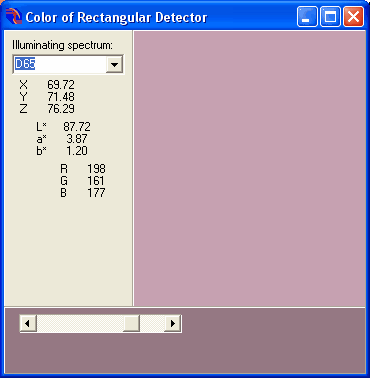
Taking 0 to 5 dots of pigment tpye P2 gives the following spectra and color coordinates:

