This section shows how pigment research can be assisted by SPRAY. Knowing the optical constants of the involved pigment materials can save a lot of experiments and time. Instead of realizing many samples and doing many measurements you can predict the optical performance of a system with SPRAY. You should, of course, check the established relations and numbers with selected real cases.
Here we investigate the following questions:
| • | Does the color of a paint change with pigment size? |
| • | How thick must the coating of a particle be in order to hide the interior completely? |
| • | How depends the reflectance spectrum of a multiply coated plate on the viewing angle? |
Pigment size variation
What happens to the color of a paint if you change the particle size? Here we show how the predicted color of the 'P1 paint' (see above) depends on the size of the pigment particles. Increasing the size from 200 to 500 nm (average radius) leads to a noticeable change in visual appearance:
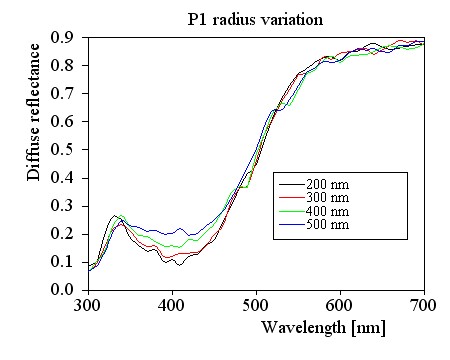
The corresponding color changes are significant:

Turning carbon into gold ...
With SPRAY you can investigate single and multiple coatings of spherical particles. Sometimes pigments are coated on purpose in order to achieve a certain appearance or other function, sometimes 'natural' coatings like surface oxides exist and have to be taken into account.
The demo question for coated spheres is this: How thick must a gold layer be on carbon particles (average size about 2 μm) in order to make the pigments look like solid gold nuggets of the same size?
Well, with SPRAY you can just try. The next graphs show the reflectance spectra (for the simple paint model discussed above) of various test 'samples' including pure carbon and pure gold. The thickness of the gold coating is indicated in the legend:

The coating should have a thickness of at least 50 nm. But even at 60 nm thickness the color coordinates are still different from those of a 'solid gold paint'. The latter are indicated by the gray lines in the graph below:

Inspecting advanced coatings
Finally we show an example of complex coatings. Any object in SPRAY may be covered with an almost arbitrary layer stack. Here a glass plate is covered with a 12 layer coating. The coating is made repeating the basic stack [TiO2 (10 nm) / SiO2 (50 nm) / Ag (10 nm)] 4 times:

The plate has been illuminated by diffuse radiation. A special detector (with multiple angle segments) records how many rays are leaving the plate in which direction. The following plot summarizes the results: From 0 to 90 degrees the reflected radiation is displayed (0 degree is the surface normal), the range 90 ... 180 deg covers the transmitted rays:

The observed features are interference effects which depend on the angle of observation, of course.
Changing the basic stack to [TiO2 (20 nm) / SiO2 (50 nm) / Ag (10 nm)], i.e. doubling the TiO2 thickness, leads to a significant shift of the spectra:
