The optical constants of pigment P1 have been given above. The following radius distribution with 3 size classes has been assumed:

The Mie program computes the scattering and absorption data in a way such that the volume fraction of the pigments can be varied afterwards without repeating the calculation again. For a volume fraction of 1% the following absorption (blue) and scattering (red) probabilities are found:

Sorry, all scattering properties are displayed in SPRAY using wavenumbers. Wavenumbers are inverse wavelengths measured in cm (i.e. 1/cm). 10000 1/cm correspond to 1000 nm wavelength (near infrared), 25000 1/cm are 400 nm (blue end of the visible).
Note the rich structure in the scattering probability which depends on the sphere size distribution.
The rays scattered by pigment P1 get new directions according to this distribution:
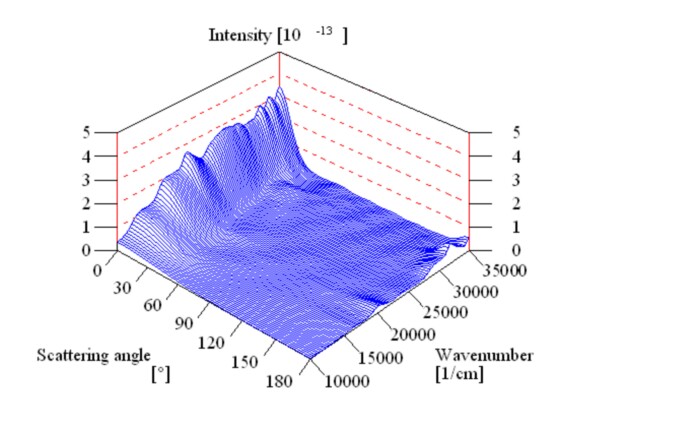
The scattering distribution depends very much on the ratio of the light wavelength and the particle radius. In the infrared (below 15000 1/cm) the ratio is large which leads to a broad angle distribution. In the UV (above 25000 1/cm) the ratio is smaller. Here the distribution is dominated by a strong and sharp forward peak and (weak) backward scattering.
Note that in the whole spectral range from the near infrared to the near UV the distribution is very different from isotropic scattering. Isotropic scattering (which is often used as a first guess) hardly occurs in real systems.